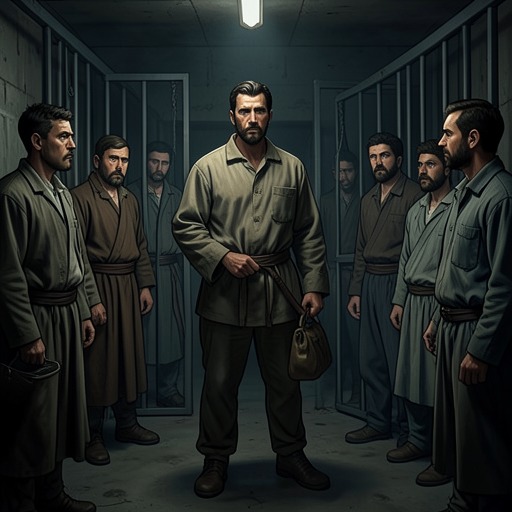
Stefan Lygas
Three SecondsStefan Lygas is a long-sentenced member of Wojtek at Aspsås prison who helps Piet Hoffmann begin taking control of the prison drug market. He is at once a practical ally in Hoffmann’s operation and a figure within the prison’s uncertain network of protection: when Hoffmann is later exposed as Paula, one of four people close enough to protect and endanger him is said to have betrayed him, but the narrative does not identify which one.
Identity and Position
Stefan is introduced as one of the two men Hoffmann particularly needs to find when he enters Aspsås prison. The other is Karol Tomasz Penderecki. Both are among four Wojtek members serving long sentences there, and both are already part of the criminal network Hoffmann intends to use. His role is therefore established through his position in a group, rather than through a separate account of his personal history: the evidence gives no biography beyond his membership, sentence, and participation in events at the prison.
The arrival marks a change in Stefan’s working relationship with Hoffmann. Before Hoffmann crosses the prison gates, he has studied the buildings and the staff and prisoners of Block G with Erik Wilson’s help, but he has not been inside Aspsås itself. Stefan is already established within that closed environment. The contrast matters: Hoffmann arrives as a new prisoner whose identity and status must be accepted by others, while Stefan can help shape how that arrival is understood.
Establishing Hoffmann’s Standing
Stefan and Karol Tomasz prepare for Hoffmann’s arrival over several days. They circulate information about why he has been taken into custody, whom he has worked with, and his standing with an Eastern European mafia. Through Stefan’s lawyer, they obtain copies of Hoffmann’s criminal-record and prison materials, including his latest judgment. These documents help make the newcomer legible to the prisoners who will assess him, supplying an apparent record that can support the identity he is presenting.
Their preparation does not eliminate the informal test of acceptance. At supper, two older prisoners demand to see Hoffmann’s papers. Stefan and Karol Tomasz rise as if to stop the confrontation, but Hoffmann signals them to hold back. He allows the challenge to proceed, responding to the demand on his own terms. The moment shows Stefan’s readiness to intervene on behalf of the operation, but also Hoffmann’s need to perform authority rather than have it exercised for him. The alliance is coordinated: Stefan helps create the conditions for Hoffmann’s entrance, while Hoffmann decides how to meet the scrutiny that follows.
Role in the Takeover
Stefan and Karol Tomasz are identified as Hoffmann’s helpers in displacing the existing competition and taking control of the prison drug market. Their part is more than welcoming a new associate. They have already prepared the ground, and Hoffmann watches for their return to the unit so that they can receive instructions. After following the principal officer to learn his cleaning duties, he waits until the other prisoners have returned from the workshop and classrooms, makes eye contact with both men, and silently signals that the action is planned for that evening.
Hoffmann’s first move is to fell the three main dealers with forty-two grams of manufactured amphetamine at a stated concentration of thirty percent. The account connects Stefan and Karol Tomasz to this operation as his helpers, though it does not detail which man performs which task. Its emphasis is on the coordinated change in power: the drug supply, rather than formal prison rank alone, can reorder the unit’s hierarchy. The larger operation depends on the work the pair has done to establish Hoffmann’s credibility and on their readiness to act when he gives the signal.
Protection, Exposure, and Uncertainty
The alliance also makes Stefan part of Hoffmann’s protection inside the prison. When Hoffmann senses that his cover is in danger, he recognizes that one person among a group of four has exposed him. The four are described collectively as his protection and his means of escape; one of them has turned against him. Since Stefan belongs to the four Wojtek members whose help and presence underpin Hoffmann’s prison operation, he falls within the circle touched by that revelation. The evidence does not, however, name him as the betrayer, and it would be inaccurate to assign him that act.
This uncertainty complicates Stefan’s earlier role. His assistance is concrete: he helps circulate Hoffmann’s credentials, stands ready during the first challenge, and awaits the signal to move against the dealers. But the same reliance on a small circle that makes the takeover possible creates a vulnerability when the undercover identity is exposed. The narrative gives Stefan importance as an operative within that circle without resolving whether his loyalty survives the operation’s collapse. His character is consequently defined less by disclosed inner life than by this unstable position between organized support and possible betrayal.